Accelerated Weighted Ensemble or AWE package provides a Python library for adaptive sampling of molecular dynamics. The framework decomposes the resampling computations and the molecular dynamics simulations into tasks that are dispatched to Work Queue for distribution and execution across allocated resources.
To use AWE, you write a Work Queue program using calls to the adpative sampler module. Then, run the work_queue_worker program on as many machines as you can access. You can start them manually, run them on the cloud, or submit them to systems like Condor or SGE. AWE will organize the machines into a workforce that, under the right conditions, can speed up protein folding by a hundred fold.
The output of AWE has been validated on the included Alanine Dipeptide protein and the WW domain dataset listed below.
@article{awe-jcim-2014,author={Abdul-Wahid, Badi and Feng, Haoyun and Rajan, Dinesh and Costaouec, Ronan and Darve, Eric and Thain, Douglas and Izaguirre, Jesus A.},title={{AWE-WQ: Fast-Forwarding Molecular Dynamics using the Accelerated Weighted Ensemble}},journal={{Journal of Chemical Information and Modeling}},volume={54},number={10},pages={3033-3043},year={2014},note={{doi: 10.1021/ci500321g}},cclpaperid={907},keywords={workqueue, awe},}
Making Work Queue Cluster-Friendly for Data Intensive Scientific Applications
Michael Albrecht, Dinesh Rajan, and Douglas Thain
In IEEE International Conference on Cluster Computing, 2013
@inproceedings{wqh-cluster13,author={Albrecht, Michael and Rajan, Dinesh and Thain, Douglas},title={{Making Work Queue Cluster-Friendly for Data Intensive Scientific Applications}},booktitle={{IEEE International Conference on Cluster Computing}},year={2013},note={{doi: 10.1109/CLUSTER.2013.6702628}},cclpaperid={898},keywords={workqueue, awe},}
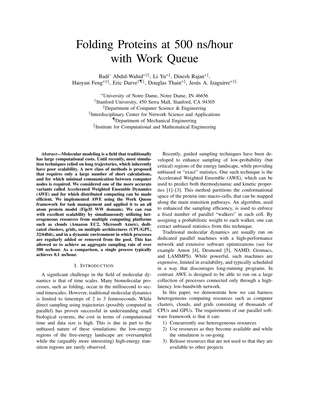
Folding Proteins at 500 ns/hour with Work Queue
Badi Abdul-Wahid, Li Yu, Dinesh Rajan, Haoyun Feng, Eric Darve, Douglas Thain, and Jesus A. Izaguirre
In 8th IEEE International Conference on eScience (eScience 2012), 2012
@inproceedings{folding-escience12,author={Abdul-Wahid, Badi and Yu, Li and Rajan, Dinesh and Feng, Haoyun and Darve, Eric and Thain, Douglas and Izaguirre, Jesus A.},title={{Folding Proteins at 500 ns/hour with Work Queue}},booktitle={{8th IEEE International Conference on eScience (eScience 2012)}},year={2012},note={{doi: 10.1109/eScience.2012.6404429}},cclpaperid={891},keywords={workqueue, awe},}
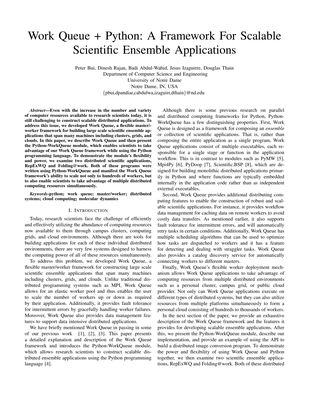
Work Queue + Python: A Framework For Scalable Scientific Ensemble Applications
Peter Bui, Dinesh Rajan, Badi Abdul-Wahid, Jesus Izaguirre, and Douglas Thain
In Workshop on Python for High Performance and Scientific Computing (PyHPC) at the ACM/IEEE International Conference for High Performance Computing, Networking, Storage, and Analysis (Supercomputing) , 2011
@inproceedings{wq-python-pyhpc2011,author={Bui, Peter and Rajan, Dinesh and Abdul-Wahid, Badi and Izaguirre, Jesus and Thain, Douglas},title={{Work Queue + Python: A Framework For Scalable Scientific Ensemble Applications}},booktitle={{Workshop on Python for High Performance and Scientific Computing (PyHPC) at the ACM/IEEE International Conference for High Performance Computing, Networking, Storage, and Analysis (Supercomputing) }},year={2011},cclpaperid={95},keywords={workqueue, awe},}